What We Know About Afrezza for Young People with Type 1 Diabetes
Research is underway to test inhaled mealtime insulin as an option alongside traditional injections. Here's what the studies are examining and when we might see results.
Evidence label explains the kind of source behind this article (for example peer-reviewed literature vs community video). It is not medical advice.
Key takeaways
- Afrezza is an inhaled insulin taken at mealtimes that researchers are testing in young people with type 1 diabetes
- Two separate clinical trials are evaluating how well Afrezza works compared to injectable rapid-acting insulins
- Studies are measuring blood sugar control, safety, and how satisfied young people and families are with the treatment
- Results are still being gathered; no conclusions about effectiveness have been published yet
A New Form, Same Insulin
Afrezza is an inhaled insulin that delivers a mealtime dose through the lungs rather than injection. For people managing type 1 diabetes, reducing the number of daily injections is an appealing idea—and that's one reason researchers are studying whether Afrezza could be a practical option, especially for children and teens.
Two Studies Under Way
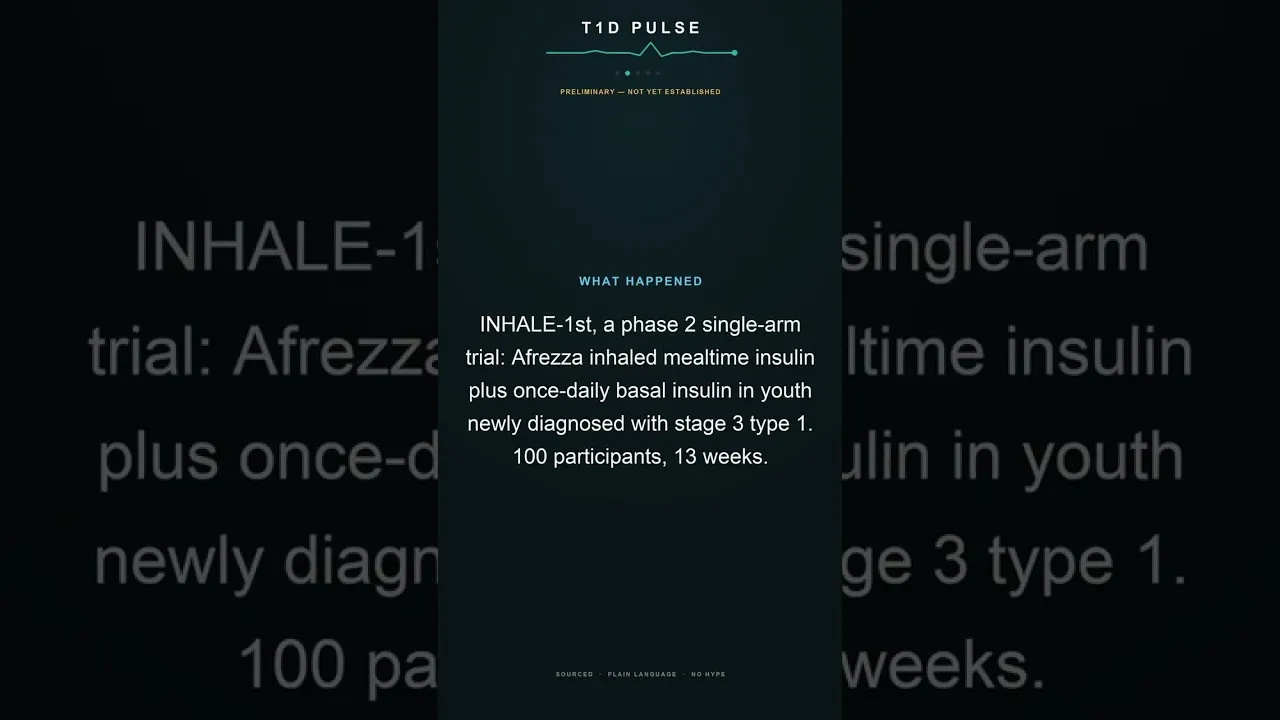
Researchers are currently running two separate clinical trials. One study, called INHALE-1st, is examining Afrezza combined with a once-daily basal insulin injection in youth newly diagnosed with type 1 diabetes. This phase 2 study involves 100 young people followed for 13 weeks, with the option to continue for up to 26 weeks.
A second study, also called INHALE-1, is a larger phase 3 randomized trial comparing Afrezza to traditional injectable rapid-acting insulins (like insulin aspart, lispro, or glulisine) in children and teens ages 4 to 18 with type 1 or type 2 diabetes. This trial has completed its main 26-week treatment phase, with all participants continuing on Afrezza through week 52 to assess long-term safety and effectiveness.
What the Studies Are Measuring
Researchers are looking at several important factors. Blood sugar control is a primary focus—specifically, how much time participants spend in their target blood sugar range as measured by continuous glucose monitors. The studies are also gathering information about how safe Afrezza is when used regularly.
Beyond the medical numbers, researchers want to understand how young people and their families feel about using inhaled insulin. Questions about satisfaction with the regimen can reveal whether a treatment is practical and livable in real life.
What We Don't Know Yet
Results from these trials have not yet been published. The INHALE-1st study is still in progress, so it will take time before we have data to review. While the larger INHALE-1 trial has moved into its extended phase, final outcomes are not yet available. Once the research is complete, the diabetes community will be able to see whether Afrezza offers meaningful benefits compared to current treatment options.
It's important to note that early-stage research like this explores possibilities; it does not yet prove that one treatment is better than another. That evidence comes only when studies are finished and results are carefully analyzed.
What This Means for You
If you or a family member is living with type 1 diabetes, these studies represent ongoing work to expand treatment choices. However, Afrezza is not yet a standard option for newly diagnosed young people with type 1 diabetes, and these trials are specifically designed to test whether it should be. Any changes to your diabetes regimen should always be made with your healthcare team, based on your individual needs and current medical evidence.
Evidence label
Origin: T1D Pulse (Video report). Evidence: Video report, corroborated with 1 indexed study. Type1Cure is an information and intelligence hub, not a medical advice service. This article summarizes published research and does not provide diagnosis, treatment, or personal medical guidance. Always talk to your own care team before changing anything about your Type 1 diabetes management.
Type1Cure is an information and intelligence hub, not a medical advice service. This article summarizes published research and does not provide diagnosis, treatment, or personal medical guidance. Always talk to your own care team before changing anything about your Type 1 diabetes management.
Related reading
More evidence-labeled coverage across the Type1Cure library.
- Diagnosis & Early DetectionUnderstanding the Stages of Type 1 Diabetes: From Invisible to DiagnosisVideo report, corroborated with 3 indexed studies
- Diagnosis & Early DetectionWhy Family Members Should Know About Type 1 Diabetes ScreeningVideo report, corroborated with 5 indexed studies
- Diagnosis & Early DetectionGenetic Screening May Help Identify Type 1 Diabetes in AdultsNews report, corroborated with 3 indexed studies
- Diagnosis & Early DetectionA Simple Blood Test May Help Doctors Assess How Severe Your DKA IsPubMed indexed literature
- Diagnosis & Early DetectionUnderstanding Type 1 Diabetes Screening: What Happens Before DiagnosisVideo report, corroborated with 3 indexed studies
- Diagnosis & Early DetectionA New Approach to Finding Type 1 Diabetes Early: Testing During Routine CheckupsPubMed indexed literature