New Gene Therapy Approaches Enter Clinical Testing for Type 1 Diabetes
Researchers are launching trials of investigational gene therapies designed to help the body remove excess blood sugar in people with type 1 diabetes. These early-stage studies represent a new direction in type 1 diabetes research.
Evidence label explains the kind of source behind this article (for example peer-reviewed literature vs community video). It is not medical advice.
Key takeaways
- Two gene therapies called VV-14299 and VV-14300 are entering human trials in adults with type 1 diabetes who use automated insulin delivery systems.
- The therapies are injected into muscle and designed to help the body remove excess sugar from the blood—they are not intended to replace insulin or restore insulin-producing cells.
- These are phase 1/2 trials, meaning they are very early stages of testing focused on safety and initial effectiveness; no results have been posted yet.
- Separately, a new automated insulin delivery system called the MicroTech Medical Equil S showed improvements in blood sugar control in recent testing with adolescents and adults.
Gene Therapy Trials Begin for Type 1 Diabetes
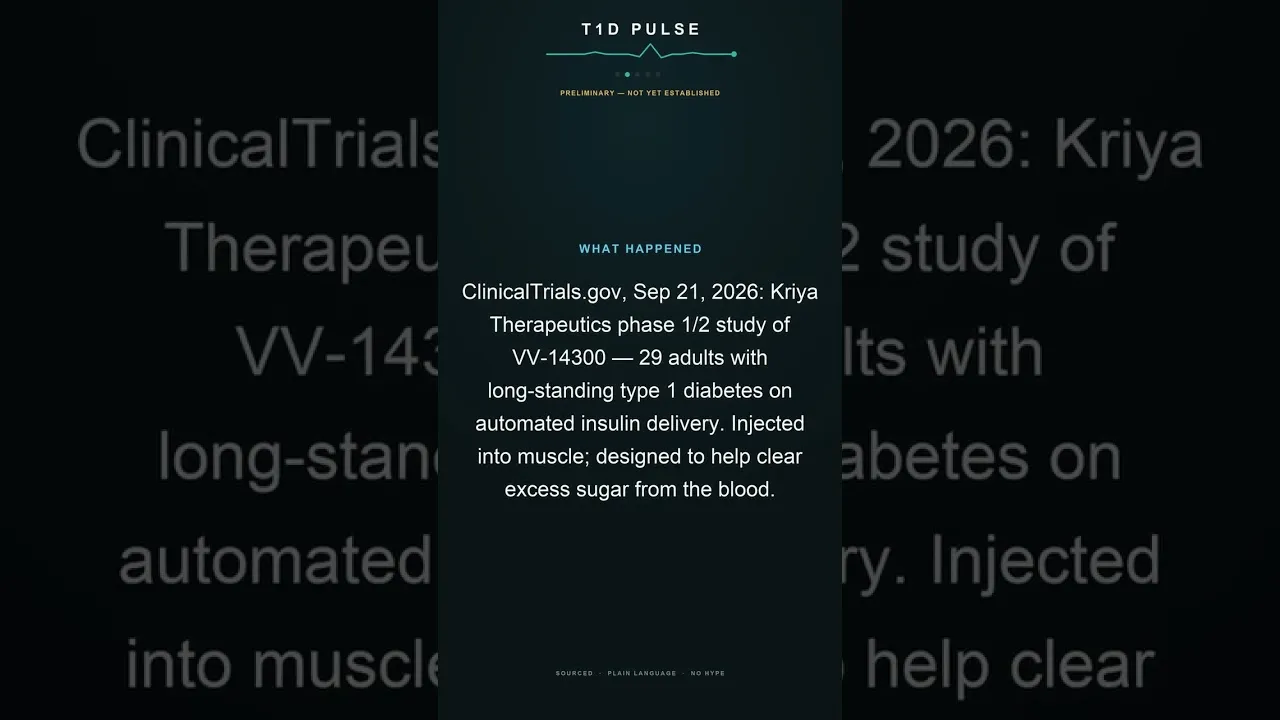
Two investigational gene therapies from Kriya Therapeutics—VV-14299 and VV-14300—are entering clinical trials for adults with long-standing type 1 diabetes whose blood sugar remains difficult to control despite using an automated insulin delivery (AID) system. The trials were registered with the U.S. National Institutes of Health on September 21, 2026.
The therapies work by being injected into muscle tissue and are designed to help the body remove excess sugar from the blood. Researchers emphasize that these are experimental treatments not available outside of clinical trials and are not designed to replace insulin or restore the body's insulin-producing cells.
What the Trials Will Measure
The phase 1/2 trial of VV-14300 alone will enroll 29 adults. The primary focus is on safety: researchers will track any adverse events, abnormal lab values, physical exam findings, and changes in vital signs. A separate trial will test both VV-14299 and VV-14300 together, or VV-14300 alone, in a similar population.
To measure whether the therapies help with blood sugar control, researchers will use continuous glucose monitors (CGMs) to track glucose levels, measure HbA1c (a marker of average blood sugar over time), and conduct a mixed meal tolerance test. Both trials are listed as not yet recruiting, and no results have been posted.
Improvements Seen With New Automated Insulin System
While gene therapy approaches are still in early testing, a separate study published in June 2026 showed promising results with a new automated insulin delivery system. The MicroTech Medical Equil S system, which combines a patch pump with a calibration-free continuous glucose monitor, was tested in 123 people with type 1 diabetes—21 adolescents and 102 adults.
After 12 weeks of using the system in automated mode, adults improved their time in range (blood sugar between 70–180 mg/dL) from about 70% to 78% of the day, and adolescents improved from about 64% to 68%. Average HbA1c levels also decreased in both groups. No episodes of severe low blood sugar or diabetic ketoacidosis occurred during the study.
What This Means
These developments show that type 1 diabetes research is moving in multiple directions—improving the technology people use today while also exploring entirely new approaches like gene therapy. The gene therapy trials represent very early work, and it will take time to understand whether these approaches are safe and effective for people living with type 1 diabetes.
If you are interested in learning more about these trials or others, you can visit ClinicalTrials.gov. As always, any questions about your own diabetes management should be discussed with your healthcare team.
Evidence label
Origin: T1D Pulse (Video report). Evidence: Video report, corroborated with 3 indexed studies. Type1Cure is an information and intelligence hub, not a medical advice service. This article summarizes published research and does not provide diagnosis, treatment, or personal medical guidance. Always talk to your own care team before changing anything about your Type 1 diabetes management.
Type1Cure is an information and intelligence hub, not a medical advice service. This article summarizes published research and does not provide diagnosis, treatment, or personal medical guidance. Always talk to your own care team before changing anything about your Type 1 diabetes management.
Related reading
More evidence-labeled coverage across the Type1Cure library.
- Cure & AdvancementsCell Replacement Therapy: A New Frontier in Type 1 Diabetes ResearchVideo report, corroborated with 5 indexed studies
- Cure & AdvancementsWhy Beta Cells Die in Type 1 Diabetes While Alpha Cells SurviveNews report, corroborated with 2 indexed studies
- Cure & AdvancementsEarly Trial Shows Some People with Type 1 Diabetes Can Reduce or Stop Insulin—Here's What We KnowNews report, corroborated with 3 indexed studies
- Cure & AdvancementsBeta Cell Therapy: Moving From Lab Promise to Real-World TreatmentVideo report, corroborated with 2 indexed studies
- Cure & AdvancementsUnderstanding the Eleodon Trial: What Early Results ShowVideo report — unverified, pending corroboration
- Cure & AdvancementsIslet Cell Therapies Advance: What You Need to KnowNews report, corroborated with 3 indexed studies