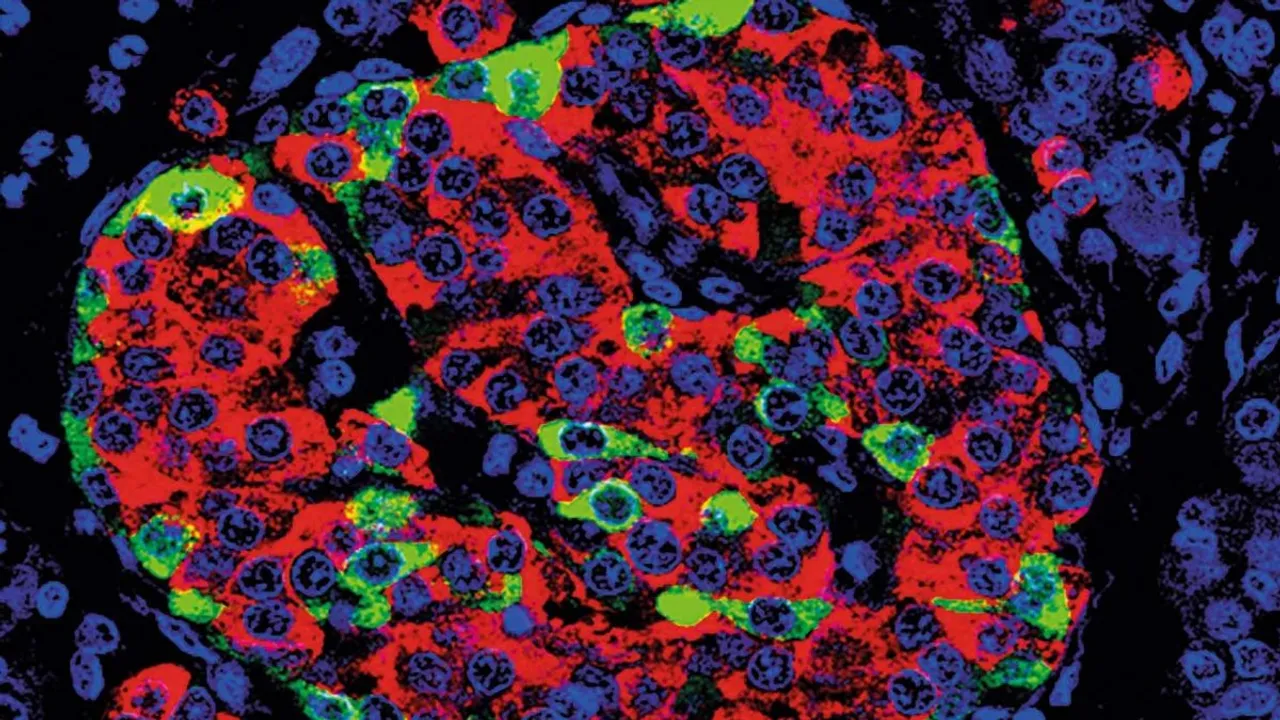
Stem Cell Research Offers New Path to Restore Insulin Production in Type 1 Diabetes
Scientists are using stem cells to grow insulin-producing beta cells in the lab, offering a potential way to replace cells destroyed by Type 1 diabetes. Early research shows promise, though clinical applications are still years away.
Evidence label explains the kind of source behind this article (for example peer-reviewed literature vs community video). It is not medical advice.
Key takeaways
- Researchers can now grow insulin-producing beta cells from stem cells in laboratory settings, addressing the core problem in Type 1 diabetes where the immune system destroys these cells.
- Both embryonic stem cells and induced pluripotent stem cells (made from a person's own skin or other cells) are being used in research to develop personalized treatments.
- Scientists have mapped how insulin-producing cells develop in human embryos, discovering they form earlier and in specific locations within the pancreas than previously known.
- Preserving pancreatic islets through advanced freezing techniques is improving their viability and function for potential future transplantation.
- While these developments are encouraging, stem cell therapies for Type 1 diabetes remain experimental and are not yet available as treatments.
Understanding the Problem Stem Cells Could Solve
Type 1 diabetes occurs when the immune system mistakenly attacks and destroys insulin-producing beta cells in the pancreas. Without these cells, the body cannot produce the insulin needed to control blood sugar levels. For decades, scientists have searched for ways to replace these lost cells—and stem cell research is emerging as a promising avenue.
The appeal of stem cells lies in their unique ability to transform into any cell type in the human body. By directing stem cells to become beta cells in the laboratory, researchers hope to create a renewable source of replacement cells for people with Type 1 diabetes.
Two Types of Stem Cells in the Race
Scientists are pursuing two main stem cell approaches. Embryonic stem cells, first isolated in 1998, are pluripotent—meaning they can develop into virtually any cell type. Researchers have used these cells for nearly 30 years to study cell development and disease.
A more recent breakthrough came in 2007 when scientists discovered how to reprogram mature cells, like skin cells, back into a stem cell-like state. These are called induced pluripotent stem cells (iPSCs). A key advantage of iPSCs is that they can be made from a patient's own cells, potentially allowing for personalized treatments tailored to each person's biology.
Mapping How Insulin Cells Form
To develop better stem cell therapies, researchers need to understand exactly how beta cells form naturally in the human body. Recent research used advanced imaging techniques to map the development of the human pancreas during pregnancy, revealing new insights into where and when insulin-producing cells first appear.
Scientists discovered that insulin-positive cells emerge as early as five weeks after conception—two weeks earlier than previously documented. These cells don't form randomly; they develop in a specific central region of the pancreas. Importantly, the study also identified that pancreatic progenitor cells (cells that can become beta cells) thrive in a separate location at the pancreas's outer edges. This finding suggests the pancreas has distinct zones for producing new cells and for developing specialized beta cells.
Preserving Cells for Future Use
A major challenge in developing stem cell and islet transplant therapies is preserving cells for storage and transport. Researchers are making progress on this front using improved freezing techniques. Recent studies show that pancreatic islets can be successfully frozen using a substance called trehalose, combined with a specialized cell-penetrating peptide, and then thawed while maintaining their ability to produce insulin.
In laboratory experiments with animals, frozen and thawed islets successfully restored blood sugar control when transplanted into diabetic mice. While these results are promising, the work remains in the experimental phase and is not yet available as a clinical treatment.
What Comes Next
Stem cell research for Type 1 diabetes is advancing steadily, but important steps remain before therapies reach patients. Researchers must continue refining techniques to grow beta cells from stem cells, understand how to prevent the immune system from attacking new cells, and develop safe, effective transplantation methods.
For people with Type 1 diabetes and their families, these developments represent genuine scientific progress—not a near-term cure, but a growing foundation of knowledge that could lead to transformative treatments in the future.
Evidence label
Origin: sciencealert.com (News report). Evidence: News report, corroborated with 2 indexed studies. Type1Cure is an information and intelligence hub, not a medical advice service. This article summarizes published research and does not provide diagnosis, treatment, or personal medical guidance. Always talk to your own care team before changing anything about your Type 1 diabetes management.
Type1Cure is an information and intelligence hub, not a medical advice service. This article summarizes published research and does not provide diagnosis, treatment, or personal medical guidance. Always talk to your own care team before changing anything about your Type 1 diabetes management.
Related reading
More evidence-labeled coverage across the Type1Cure library.
- Cure & AdvancementsCell Replacement Therapy: A New Frontier in Type 1 Diabetes ResearchVideo report, corroborated with 5 indexed studies
- Cure & AdvancementsWhy Beta Cells Die in Type 1 Diabetes While Alpha Cells SurviveNews report, corroborated with 2 indexed studies
- Cure & AdvancementsEarly Trial Shows Some People with Type 1 Diabetes Can Reduce or Stop Insulin—Here's What We KnowNews report, corroborated with 3 indexed studies
- Cure & AdvancementsBeta Cell Therapy: Moving From Lab Promise to Real-World TreatmentVideo report, corroborated with 2 indexed studies
- Cure & AdvancementsUnderstanding the Eleodon Trial: What Early Results ShowVideo report — unverified, pending corroboration
- Cure & AdvancementsIslet Cell Therapies Advance: What You Need to KnowNews report, corroborated with 3 indexed studies