New Drug Combination Shows Promise in Islet Transplant Study—With Potential Kidney Benefits
A small early-stage trial tested a different anti-rejection approach for people receiving insulin-producing cell transplants. Eight of nine participants avoided severe low blood sugars at one year.
Evidence label explains the kind of source behind this article (for example peer-reviewed literature vs community video). It is not medical advice.
Key takeaways
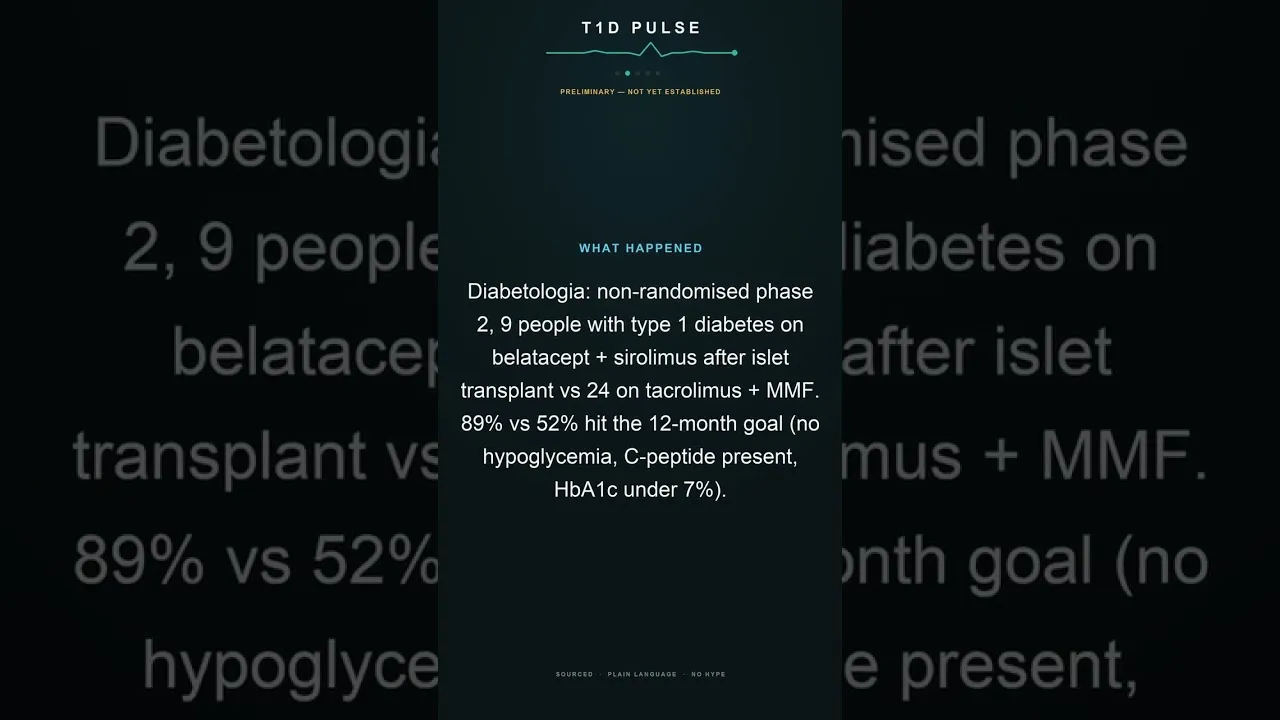
- Belatacept plus sirolimus kept 89% of transplant recipients free from hypoglycemia at 12 months, compared to 52% on standard anti-rejection drugs
- This is very early evidence from nine people in one small study—not a cure, and results need confirmation in larger trials
- The new combination appeared to preserve kidney function, while standard tacrolimus-based regimens can harm the kidneys over time
- Islet transplant itself is only an option for select people with Type 1 diabetes who cannot sense their low blood sugars
What Is Islet Transplantation?
Islet transplantation involves infusing insulin-producing cells from a donor pancreas into a person with Type 1 diabetes. It is not a cure and is reserved for a narrow group of patients: those with severe, recurrent hypoglycemia unawareness—meaning they cannot feel when their blood sugar drops dangerously low. This complication puts them at high risk of seizures, accidents, and other life-threatening episodes.
The Study: A New Anti-Rejection Strategy
Transplant recipients must take anti-rejection drugs for life to prevent their immune system from destroying the donor cells. Researchers in a small phase 2 trial tested whether belatacept and sirolimus—a different combination from the standard tacrolimus-based regimen—could work better.
Nine people received the new drug pairing. At 12 months, eight of them (89%) met three key goals: no episodes of hypoglycemia, detectable C-peptide (a sign the transplanted cells were working), and an A1C below 7%. By comparison, only about half (52%) of transplant recipients on standard anti-rejection drugs achieve all three milestones in the first year.
A Potential Advantage: Kidney Protection
One notable finding: kidney function remained stable in the belatacept group, whereas tacrolimus—the standard anti-rejection drug—can damage kidney function over time. This matters because transplant recipients already face kidney strain from diabetes and immunosuppression. Preserving kidney health could mean a better quality of life and fewer complications for people on long-term anti-rejection therapy.
What This Means Right Now
This is very early evidence from a single small trial with nine participants and no comparison group randomized in a rigorous way. The results are encouraging but not definitive. Larger, well-designed studies would be needed before this approach becomes standard practice.
Islet transplant remains a specialized procedure for a specific population. Anyone considering transplant or already living with a transplant should discuss all anti-rejection options—including new approaches as they emerge—with their transplant team.
Evidence label
Origin: YouTube / T1D Pulse (Video report). Evidence: Video report — unverified, pending corroboration. Type1Cure is an information and intelligence hub, not a medical advice service. This article summarizes published research and does not provide diagnosis, treatment, or personal medical guidance. Always talk to your own care team before changing anything about your Type 1 diabetes management.
Type1Cure is an information and intelligence hub, not a medical advice service. This article summarizes published research and does not provide diagnosis, treatment, or personal medical guidance. Always talk to your own care team before changing anything about your Type 1 diabetes management.
Related reading
More evidence-labeled coverage across the Type1Cure library.
- Cure & AdvancementsGene-Edited Islets Show Promise, But Long-Term Questions RemainPubMed indexed literature
- Cure & AdvancementsNew Immune Therapies Show Promise in Early Type 1 Diabetes TrialsVideo report, corroborated with 2 indexed studies
- Cure & AdvancementsNew Method Creates Better Insulin-Producing Cell Clusters for Transplant StudiesPubMed indexed literature
- Cure & AdvancementsA Vitamin A Compound Shows Promise in Rodent Models of Type 1 DiabetesPubMed indexed literature
- Cure & AdvancementsYears Before Diagnosis: New Study Maps Autoantibody Patterns in Adult-Onset Type 1 DiabetesPreprint (not peer reviewed), corroborated with 3 indexed studies
- Cure & AdvancementsNew Research Explores How a Cellular Pathway May Influence Insulin ProductionPreprint (not peer reviewed) — unverified, pending corroboration