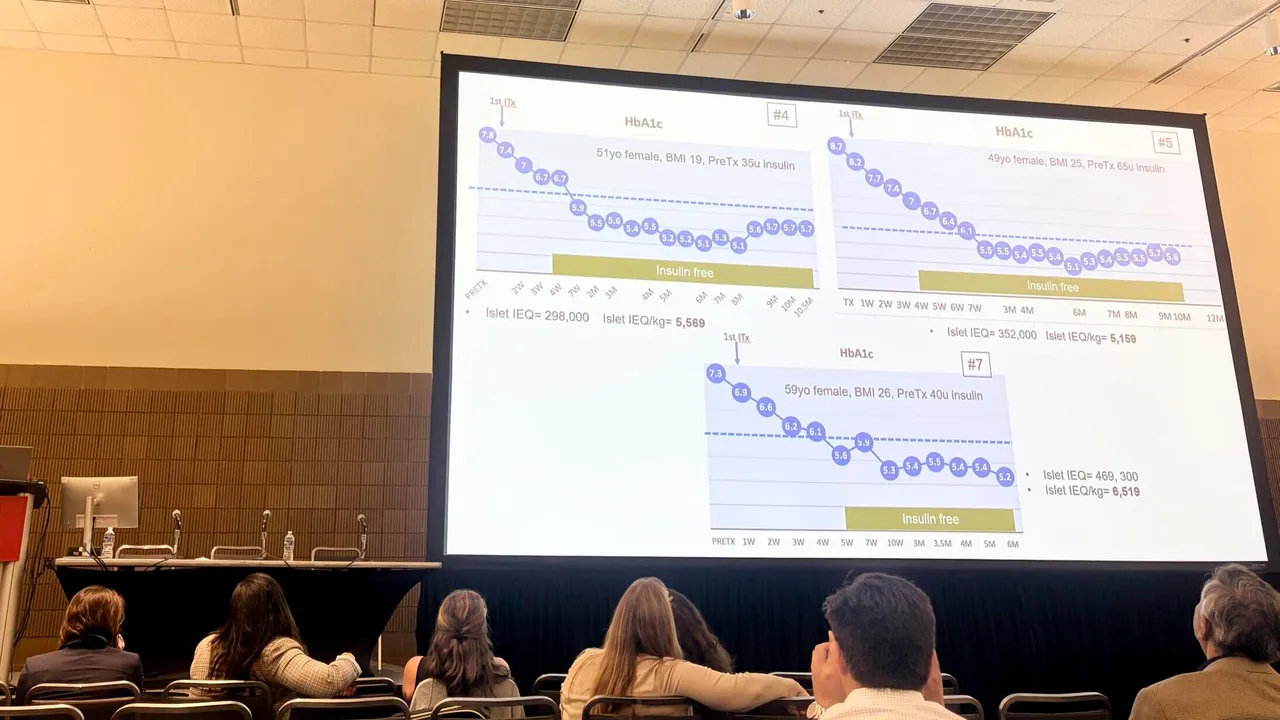
All 12 Islet Transplant Patients Stop Taking Insulin in Tegoprubart Trial
New data from a University of Chicago study shows that an experimental immunotherapy called tegoprubart may offer a safer alternative to standard anti-rejection drugs in islet cell transplants for Type 1 diabetes.
Evidence label explains the kind of source behind this article (for example peer-reviewed literature vs community video). It is not medical advice.
Key takeaways
- All 12 participants in the pilot study are currently off external insulin after receiving transplanted islet cells
- Tegoprubart is a targeted immune therapy that blocks the specific rejection signal rather than broadly suppressing the entire immune system
- Early data shows no severe low blood sugar events, no cell rejection, and reduced kidney toxicity compared to the standard drug tacrolimus
- Tegoprubart is given as an infusion every three weeks and is also being tested in a separate Phase 3 trial for kidney transplants
A New Approach to Preventing Transplant Rejection
Islet cell transplantation—placing insulin-producing cells from a donor pancreas into a person with Type 1 diabetes—has shown promise as a potential treatment option. However, the procedure has a major hurdle: the body's immune system naturally attacks foreign tissue. To prevent this rejection, transplant recipients typically take tacrolimus, a drug that broadly suppresses immune function. The downside is that tacrolimus can be toxic to both the transplanted cells and the patient's body, particularly the kidneys.
Tegoprubart, an investigational immunotherapy developed by Eledon Pharmaceuticals, offers a different strategy. Instead of dampening the entire immune system, it targets one specific signal that tells the body to reject transplanted tissue. Researchers believe this precision approach could reduce harm to patients and transplanted cells alike.
Promising Early Results
Data presented at the American Diabetes Association's 86th Scientific Sessions in June 2026 showed early promise for tegoprubart in islet transplantation. All 12 participants in the pilot study—conducted at the University of Chicago and funded by Breakthrough T1D and partners—are currently off external insulin.
The study found no severe hypoglycemic (low blood sugar) events, no signs of the transplanted cells being rejected, and no significant kidney toxicity. Participants have not experienced unexpected adverse events. These findings suggest that tegoprubart may be a more tolerable option than tacrolimus for islet transplant recipients.
What's Next
Tegoprubart is currently in Phase 3 clinical trials for kidney transplants, a larger and more rigorous stage of testing. The islet transplant work remains in earlier stages. These results are encouraging, but it's important to remember that pilot studies involve small numbers of participants and more research is needed to confirm safety and effectiveness across larger populations.
For people with Type 1 diabetes considering islet transplantation or following developments in immunotherapy, this work represents one of several ongoing efforts to improve transplant outcomes and reduce the burden of immunosuppressive medications.
Evidence label
Origin: breakthrought1d.org (News report). Evidence: News report, corroborated with 1 indexed study. Type1Cure is an information and intelligence hub, not a medical advice service. This article summarizes published research and does not provide diagnosis, treatment, or personal medical guidance. Always talk to your own care team before changing anything about your Type 1 diabetes management.
Type1Cure is an information and intelligence hub, not a medical advice service. This article summarizes published research and does not provide diagnosis, treatment, or personal medical guidance. Always talk to your own care team before changing anything about your Type 1 diabetes management.
Related reading
More evidence-labeled coverage across the Type1Cure library.
- Cure & AdvancementsCell Replacement Therapy: A New Frontier in Type 1 Diabetes ResearchVideo report, corroborated with 5 indexed studies
- Cure & AdvancementsWhy Beta Cells Die in Type 1 Diabetes While Alpha Cells SurviveNews report, corroborated with 2 indexed studies
- Cure & AdvancementsEarly Trial Shows Some People with Type 1 Diabetes Can Reduce or Stop Insulin—Here's What We KnowNews report, corroborated with 3 indexed studies
- Cure & AdvancementsBeta Cell Therapy: Moving From Lab Promise to Real-World TreatmentVideo report, corroborated with 2 indexed studies
- Cure & AdvancementsUnderstanding the Eleodon Trial: What Early Results ShowVideo report — unverified, pending corroboration
- Cure & AdvancementsIslet Cell Therapies Advance: What You Need to KnowNews report, corroborated with 3 indexed studies