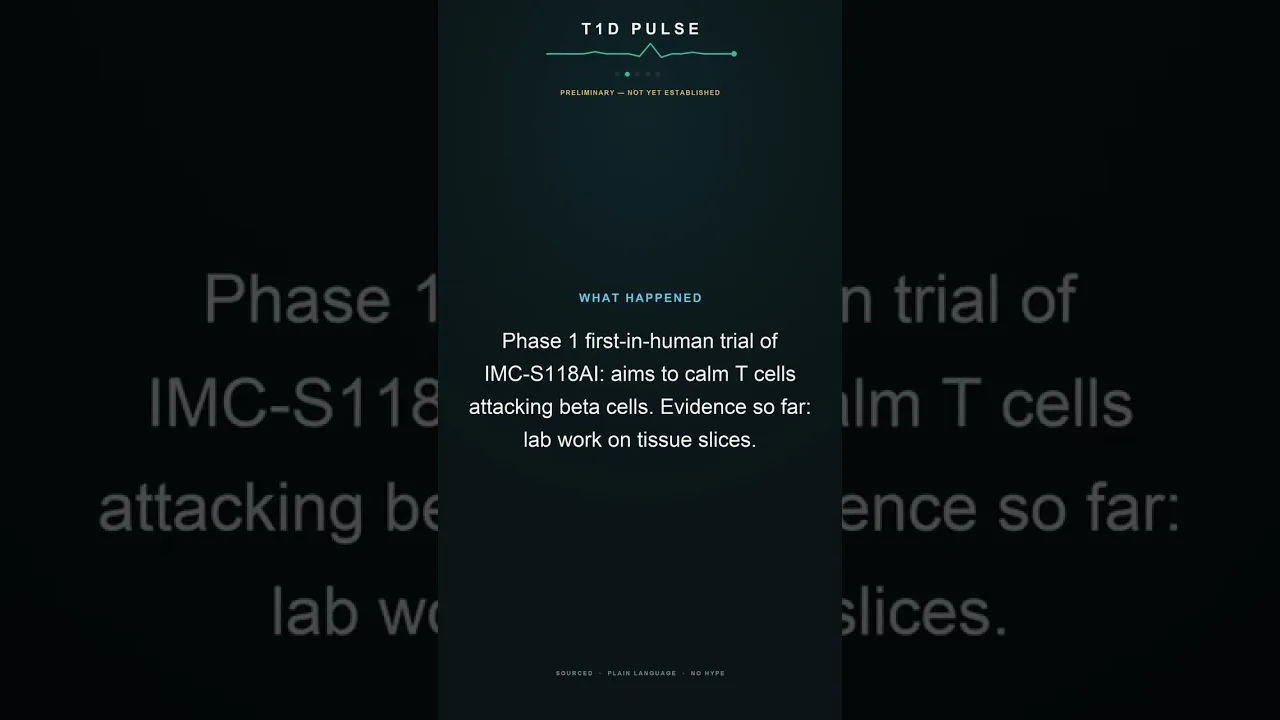
New Bispecific Therapy for Type 1 Diabetes Enters First Human Trial
Immunocore has dosed the first patient in an early-stage study of IMC-S118AI, an experimental immune-targeted treatment designed for people with a specific genetic marker. Here's what we know so far.
Evidence label explains the kind of source behind this article (for example peer-reviewed literature vs community video). It is not medical advice.
Key takeaways
- IMC-S118AI is a bispecific molecule—a type of drug engineered to target two specific points in the immune system at once.
- The trial is open only to people with the HLA-A*02:01 genetic marker, which affects how the immune system presents antigens to immune cells.
- This is a phase 1 trial, the earliest stage of human testing, focused on safety and basic tolerability rather than proving the drug works.
- Laboratory work using human pancreas tissue supported the decision to move forward to testing in people.
What Is IMC-S118AI?
IMC-S118AI is an investigational bispecific molecule—a type of drug designed to bind to two different targets at the same time. In this case, Immunocore engineered it to interact with the immune system in a way that may help control the autoimmune attack on pancreatic beta cells in type 1 diabetes.
Bispecific therapies represent a newer approach to treating autoimmune diseases. By engaging multiple immune pathways simultaneously, they may offer more precise control over immune responses than older generations of immune-modifying drugs.
Who Can Participate?
The phase 1 trial is limited to people who carry the HLA-A*02:01 genetic variant. The human leukocyte antigen (HLA) system is part of the immune system that presents antigens—molecular patterns—to immune cells. Different HLA variants affect how the immune system 'sees' these patterns.
Approximately 40% of people of European ancestry carry HLA-A*02:01, though frequency varies across populations. The restriction to this genetic group reflects how the drug was designed in the laboratory and helps researchers understand its effects in a more controlled way during early testing.
What Stage Is This Trial?
Phase 1 is the earliest stage of human testing. The primary goals are to evaluate safety, tolerability, and basic pharmacology—how the drug moves through the body and whether it causes side effects.
Phase 1 trials do not aim to prove whether a drug actually works to prevent or reverse disease. That evaluation comes later, in phase 2 and phase 3 trials. Success in phase 1 means the drug appears safe enough and well-tolerated enough to proceed to the next stage.
What Laboratory Work Supports This?
Before advancing to human testing, Immunocore's team studied IMC-S118AI using slices of human pancreas tissue. This work helped researchers understand how the drug behaves in tissue that reflects the actual target—the pancreas—without involving a living person.
Laboratory and tissue studies are important steps before human trials, but they cannot predict all real-world effects. That is why clinical trials in people remain essential.
What Does This Mean for Type 1 Diabetes?
This milestone represents continued investment in immune-targeted approaches to type 1 diabetes. The field is exploring many strategies to control or reverse the autoimmune process, though no disease-modifying treatments have yet been approved for broad use.
If early safety data support it, future trials will test whether IMC-S118AI can slow disease progression or preserve beta cell function. Those results, if positive, would still need confirmation in larger studies before the drug could reach patients. We are in the early exploratory phase, and many steps remain.
Evidence label
Origin: T1D Pulse (Video report). Evidence: Video report — unverified, pending corroboration. Type1Cure is an information and intelligence hub, not a medical advice service. This article summarizes published research and does not provide diagnosis, treatment, or personal medical guidance. Always talk to your own care team before changing anything about your Type 1 diabetes management.
Type1Cure is an information and intelligence hub, not a medical advice service. This article summarizes published research and does not provide diagnosis, treatment, or personal medical guidance. Always talk to your own care team before changing anything about your Type 1 diabetes management.
Related reading
More evidence-labeled coverage across the Type1Cure library.
- Causes & What We KnowWhat We Know About How Type 1 Diabetes DevelopsVideo report, corroborated with 1 indexed study
- Causes & What We KnowPregnant Women with Diabetes Show Higher Rates of Toxoplasma InfectionPubMed indexed literature
- Causes & What We KnowExploring Rare Breast Inflammation: What BRCA Mutations and Type 1 Diabetes May SharePubMed indexed literature
- Causes & What We KnowUnderstanding Type 1 Diabetes: A Shift Toward Early InterventionPubMed indexed literature
- Causes & What We KnowHow Nutrition, Metabolism, and Immunity Connect: What the Lectin Pathway Tells UsPubMed indexed literature
- Causes & What We KnowA Rare Skin Condition in Young Children with Type 1 Diabetes: What Parents Should KnowPubMed indexed literature